- Elliot from Ghost Team
- Posts
- 18 lessons from building 100+ ChatGPT apps (with Fractal's co-founder)
18 lessons from building 100+ ChatGPT apps (with Fractal's co-founder)
And you can now track Claude Connectors (MCP Apps)!

Elliot Garreffa
February 26, 2026
Hey builders,
Just in the last 7 days, these brands went live with ChatGPT Apps or Claude Connectors: Lowe's, HubSpot, Meetup, TourRadar, Voyage Privé, PayPal, Outreach, PlanetScale, PitchBook - and 16 more.
25 new apps in a single week. Many of them household names. The world's biggest businesses are taking this very seriously.
So with so many people now asking "how do I actually build one of these?" - Hanh Nguyen (co-founder of Fractal) and I decided to sit down and answer that properly.
Between us we've built well over 100 ChatGPT apps. We jumped on a call and broke down exactly what it takes to build a successful one - from the first idea all the way through to getting it discovered.
Here's a high-level breakdown of some of the things we discussed:
1. Common confusion: ChatGPT Apps are not GPTs. Not web apps. Not mobile apps. They're a completely new paradigm.
2. We're moving from the "fragmented web" to the "intent-based web." You use to design for you finding the tool. Now you design for the the tool finding you.
3. Don't start by listing features and building tools. Start with use cases. What will people actually type?
5. The model controls the flow, not you. Biggest mental shift from web/mobile dev.
6. "Tool description" is the wrong name. It's a tool instruction. Treat it that way. Most builders write "Search hotels" and wonder why it never gets called. Be specific.
7. Include WHEN to use your tool AND when NOT to. Negative use cases matter just as much.
8. Add example prompts to instructions. "Use when people say X, Y, Z" dramatically improves call rates.
9. Leverage ChatGPT's intelligence inside metadata. e.g. "If user doesn't specify a city, check history and suggest favourites."
10. Prototype with mock data before building any API if you don't have one already. Test the conversation until it feels right. Only then build backend.
11. Think bulk operations. Instacart adds all recipe ingredients in one call - not 20 separate ones.
12. Know partial tool calls vs follow-up messages. Same-UI refinement = partial call. New results = follow-up. Get this wrong and the experience feels broken.
13. ChatGPT knows more about users than almost any platform ever. Use that for personalisation.
15. Two surfaces to optimise: the UI widget AND the chat. Websites have UI. Chatbots have chat. You have both.
16. Use developer mode to inspect how top apps handle tool calls. You'll learn a lot from their metadata.
17. Build retry logic into tool instructions. Failed searches are inevitable - define how to recover.
18. ChatGPT App Store discovery is one of the key ways your app gets found. Optimise your metadata, keywords, and descriptions from day one and track how you compare against competitors. Lots of app store data accessible at appdiscoverability.com/track.
19. Organic discovery is why most people are excited about building ChatGPT apps. Your app gets recommended at the end of a user's prompt based on their intent. It's not fully live yet - but there's a lot you can do now to optimise for when it launches.
A really fun conversation. Make sure to let me know if you think there are any that we missed!
AppDiscoverability.com just got a big upgrade 👇
We've been tracking the ChatGPT App Store since day one - and this week we shipped something new.
We're now tracking Claude Connectors too.
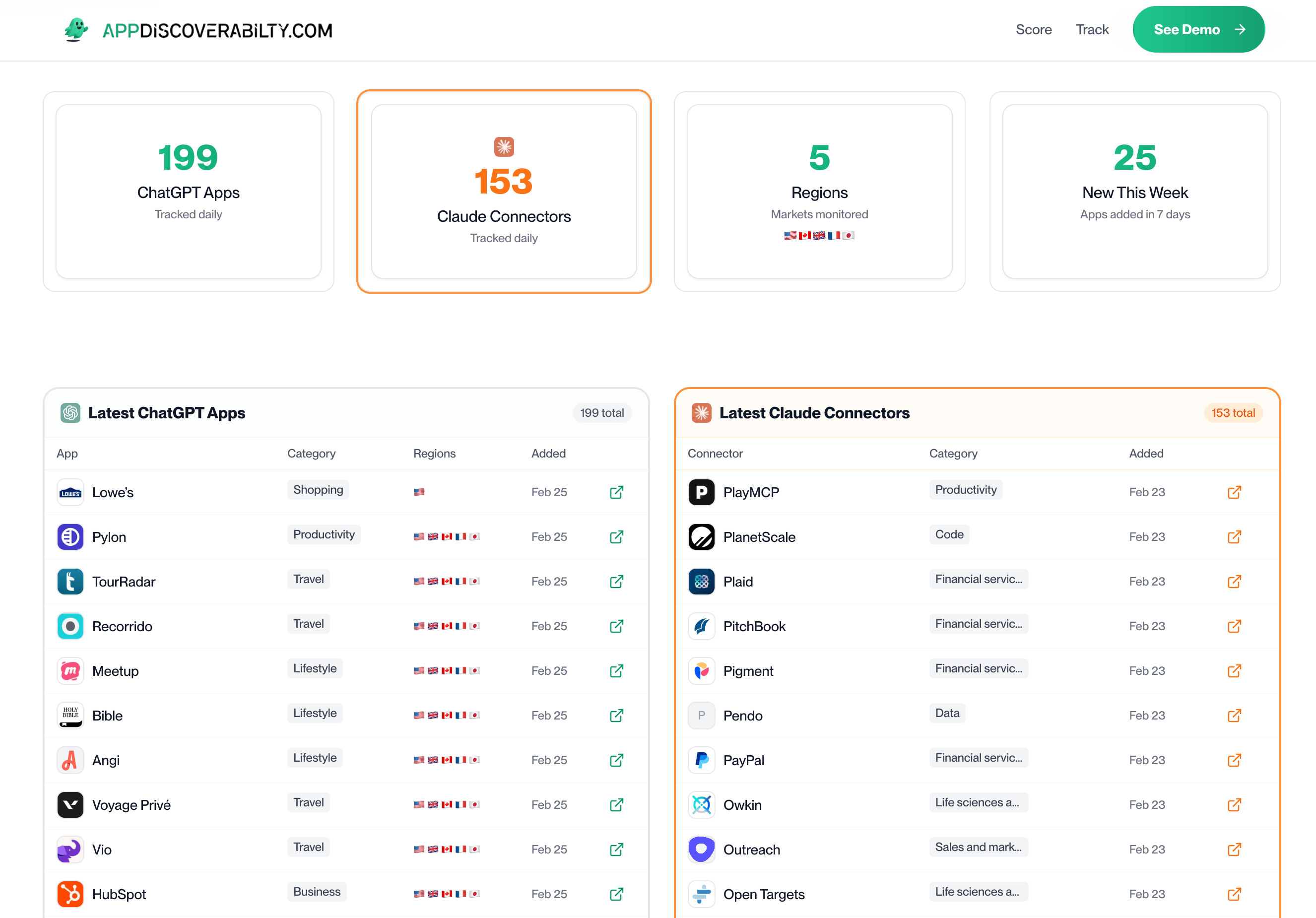
153 Claude Connectors. 199 ChatGPT Apps. 5 regions monitored. 25 new apps added just this week.
And we've built a cross-platform intelligence view so you can see exactly how the two ecosystems compare:
60 apps (32% of ChatGPT) are live on both platforms
130 apps are ChatGPT only
84 apps are Claude only
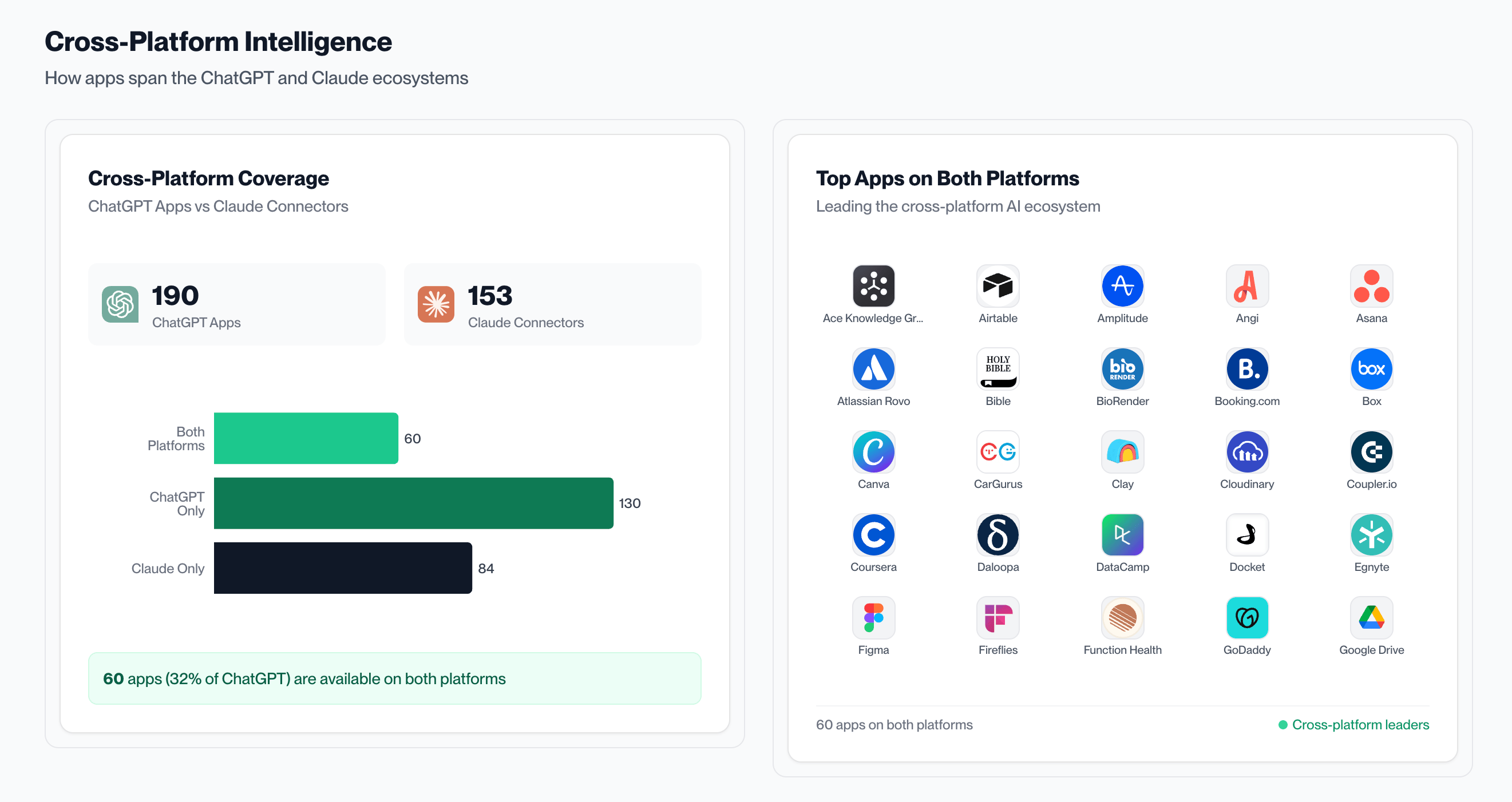
What’s clear is that companies aren't just picking one platform. They're launching on both. Right now, 60 apps (32% of all ChatGPT apps) are already live on both platforms. These are the cross-platform leaders:
Many companies people will recognise are doing this:
Ace Knowledge Graph, Airtable, Amplitude, Angi, Asana, Atlassian Rovo, Bible, BioRender, Booking.com, Box, Canva, CarGurus, Clay, Cloudinary, Coupler.io, Coursera, Daloopa, DataCamp, Docket, Egnyte, Figma, Fireflies, Function Health, GoDaddy, Google Drive - and 35 more.
This is a trend worth watching. The platforms are different. The audiences overlap but aren't identical. And the early movers testing both are going to have a significant advantage in understanding which prompts, which use cases, and which verticals perform best on each.
If you want to track which apps are gaining ground, which keywords are getting competitive, and where the gaps still are - head to appdiscoverability.com/track.
If you sign up to the newsletter, you can get updates to your inbox as new apps launch in ChatGPT & Claude app stores.
If anyone has any questions around MCP Apps, just reply to this email, I check every reply!
Speak soon,
Elliot
Learn how your business could grow with Apps on ChatGPT & Claude
If your company or brand is interested in getting an app inside ChatGPT & Claude, feel free to schedule with our team to discuss what the opportunity could mean for your business.