- Elliot from Ghost Team
- Posts
- The 7 Rules for ChatGPT Apps (From 316 Apps, 2,100 Tools, and Enterprise Clients)
The 7 Rules for ChatGPT Apps (From 316 Apps, 2,100 Tools, and Enterprise Clients)
Every lesson from building ChatGPT Apps for some of the world's largest companies

Elliot Garreffa
April 16, 2026
Hey builders,
I recently gave a talk at MCP Dev Summit on the principles we've learned building ChatGPT Apps and MCP Apps.
These are learnings from everything we've done at Ghost Team working with some of world’s leading enterprises combined with data from our AppDiscoverability platform where we track every app in the ChatGPT App Store & Claude Connector Store daily.
Full talk here:
Today I'm breaking down:
→ The shift from the fragmented web to the intent-based web
→ How ChatGPT Apps actually work under the hood
→ 7 principles from analyzing 316 apps and 2,100+ tools
→ An exciting announcement (… we may have been asked to speak at a CNBC event in Singapore next week…)
Let's dive in.
We are moving to the Intent-based Web
We're moving from the fragmented web to the intent-based web.
Previously you had to search, find a tool, and navigate their UI to get what you wanted. Now you just prompt - and the right tool comes to you.
Different way to discover products. Different way to use them. Changes everything about how we design these apps.
The data backs it up. In the 10 days running up to the talk, 96 apps have gone live in the ChatGPT App Store - some of the biggest brands in the world.

How ChatGPT Apps Work
Three components you need to understand:
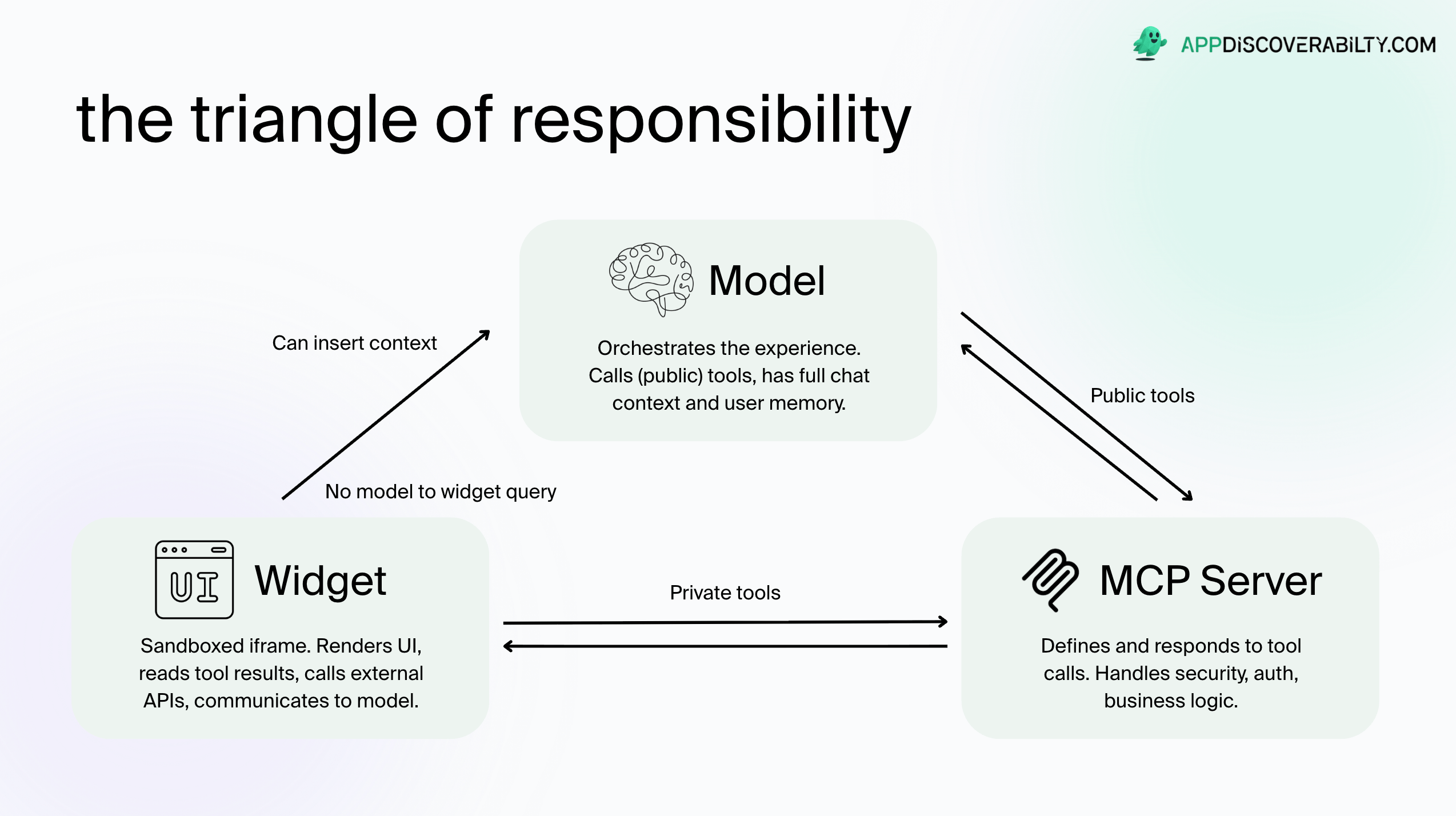
The Model - The orchestration layer. It has full context and memory of the user and conversation. It decides which tools to call and when.
The MCP Server - Your app. You define the tools, handle auth, security, and business logic.
The Widget - A sandboxed iframe where your UI lives. Gets pushed back into the conversation. Importantly, the model can't always read what's inside — which is critical for data privacy.
A user says "show me hotels in New York for tomorrow." The model picks the best tool, passes the parameters, and the widget renders the results directly in chat.
The relationship between all these components are critically important and you need to deeply understand how they work to design these apps well.
The 7 Principles
Here are 7 of the top things we’ve learnt from our experience and the data from analysing 316 apps and 2,100+ tools
1. Start With Intent
Everything is downstream of intent.
Define the intent you're going after. Understand what users are actually typing into ChatGPT - which is different from web, different from mobile. Then backwards-engineer your tools from there.
Do this on a persona basis. And be realistic about what the ecosystem can deliver today.

2. Tool Descriptions Are the New System Prompt
We analyzed 316 apps and 2,100+ tools. Here's what the best apps are doing in their tool descriptions:
→ 57% use negative constraints - telling the model what NOT to do
→ Many include error recovery instructions
→ Significant use of multi-turn context handling
Your tool description controls the entire experience. Treat it like a system prompt.

3. Let the Model Do the Work
Most apps in the store are single-tool apps. That's fine - simple is good.
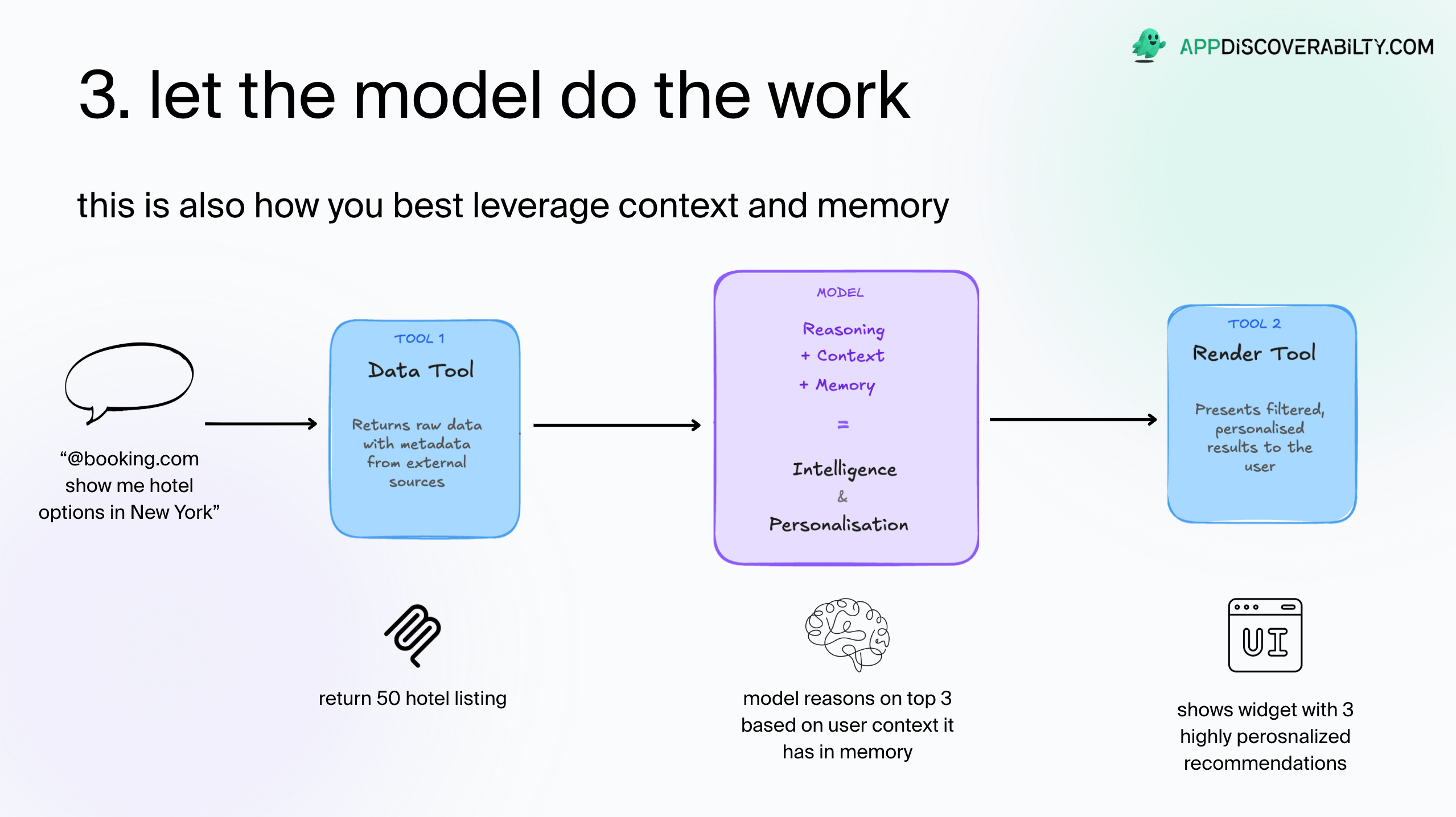
But for complex use cases, multi-tool architectures let you leverage the model's intelligence. Instead of a scoring system deciding the best result, give all the options to the model and let it decide based on intent, context, and memory.
Works especially well for personalization. 50 hotel listings? The model can surface the three most relevant based on what it knows about the user.
4. Design for Both Surfaces
In ChatGPT you've got two surfaces: the widget and the text response below it. Users look at both. They need to work together.
You control the widget. You influence the text through your tool descriptions.
Zillow instructs the model to never speculate on whether a property price is fair. Imagine the model saying "this doesn't seem like a great deal" next to a listing. Not good.

5. Design for Conversation
People don't use single prompts.
"Show me hotels in Rome." → "Make it cheaper." → "What about next week?"
Only 7% of apps design for this. Huge missed opportunity.
Expedia nails it - their tool description specifies: when someone gives an updated requirement, call the tool again with updated parameters. Don't fall back to general knowledge. Don't reference the original search.

6. Test Live
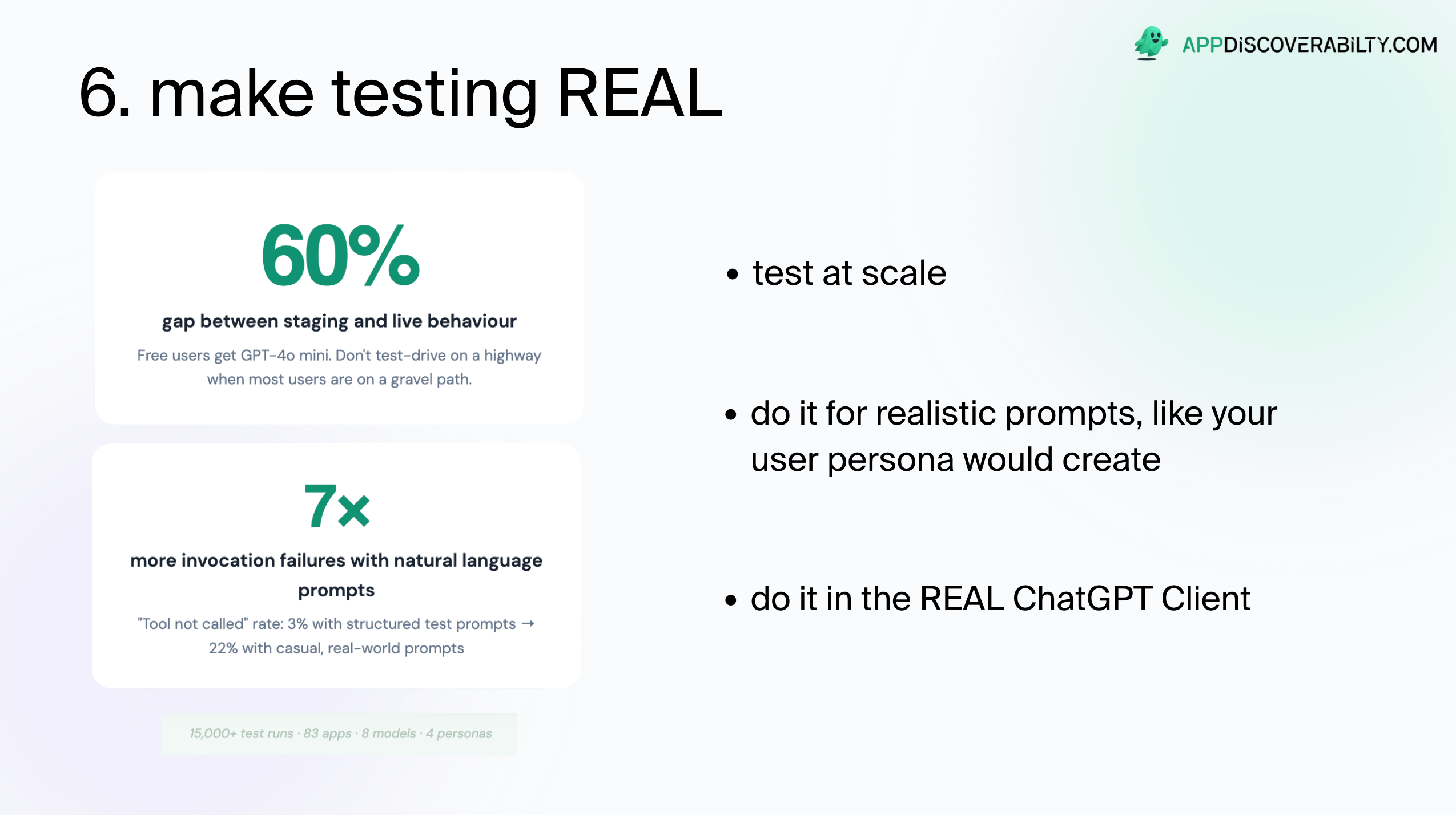
Up to 60% difference between staging and live behavior in ChatGPT.
Why? In staging, you're testing with a top model on a paid account. In reality, users are on free accounts, long conversations, and ChatGPT degrades the model over time. Completely different experience.
We also found a 7x higher failure rate with structured test prompts vs. realistic casual prompts.
→ Test at scale with realistic prompts
→ Match your actual user persona
→ Test directly in ChatGPT, not just evals
7. Build for Distribution
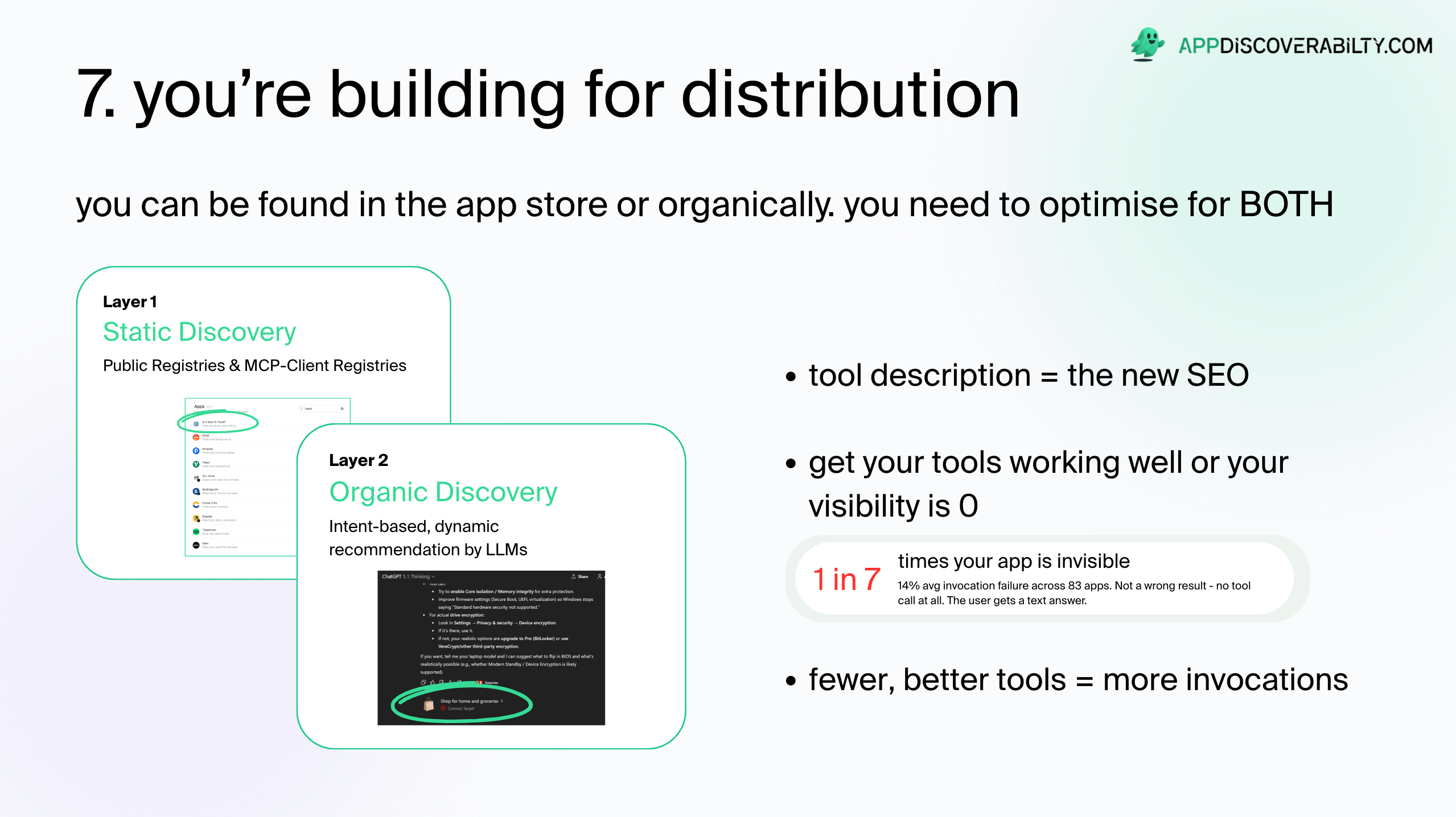
Two ways to get discovered:
Static - The App Store. Optimize your listing, your description, your keywords. In our tracker, some apps appear for way more keywords than others.
Organic - This is where it gets interesting. When a user says "book me a hotel," is your app appearing or your competitor's? Your tool description is the new SEO.
From testing 83 apps: 14% average failure rate for invocation. 1 in 7 times an app is called, it just fails. That's distribution you're leaving on the table.
And simpler apps win. Fewer tools, better tools = higher invocation rates. Less complexity for the model to reason with.
That was a lot…
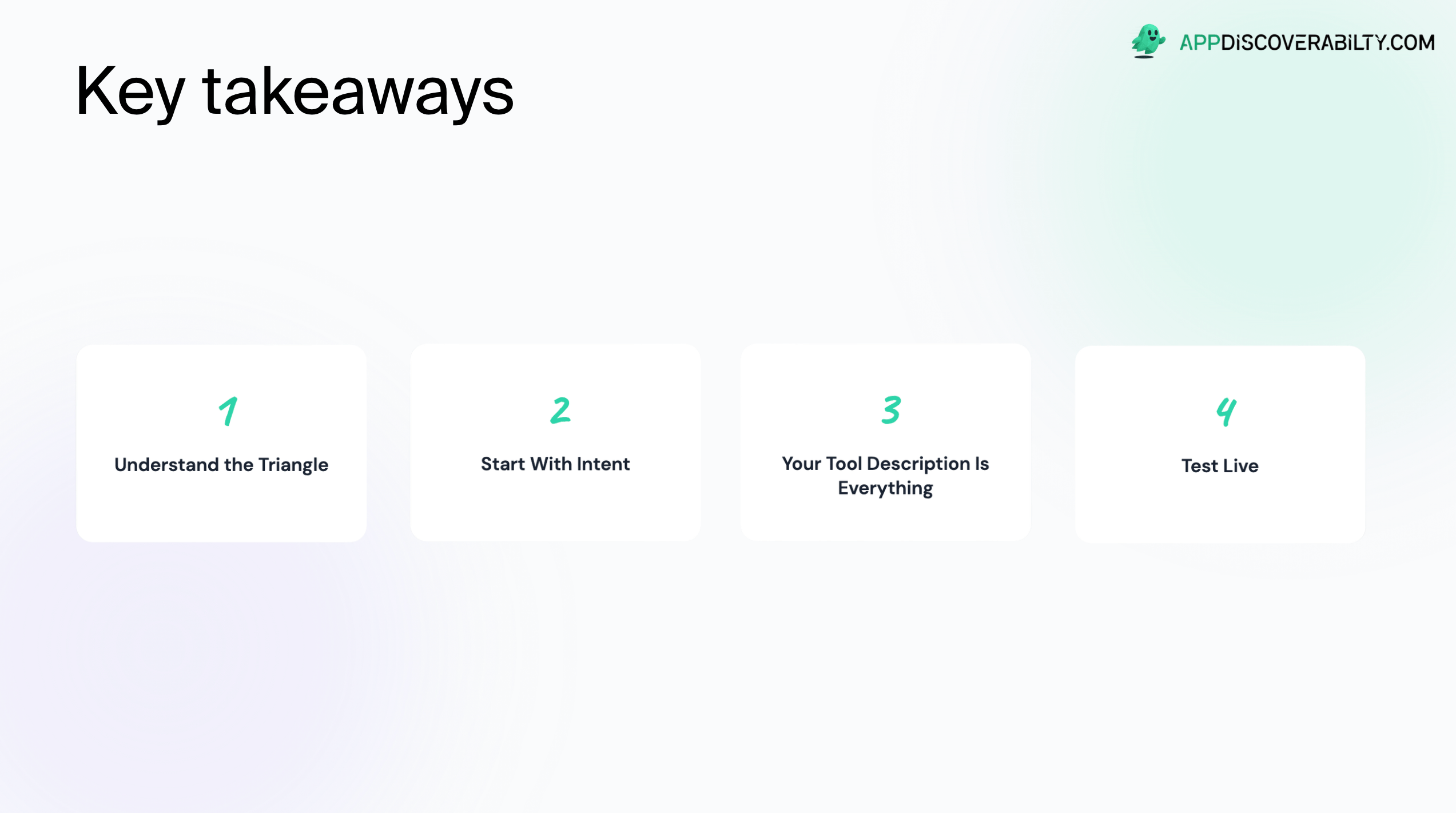
If I had to summarise, I’d say these are the most important things:
And one more thing
I’ll be speaking at CNBC Converge Live in Singapore next week.
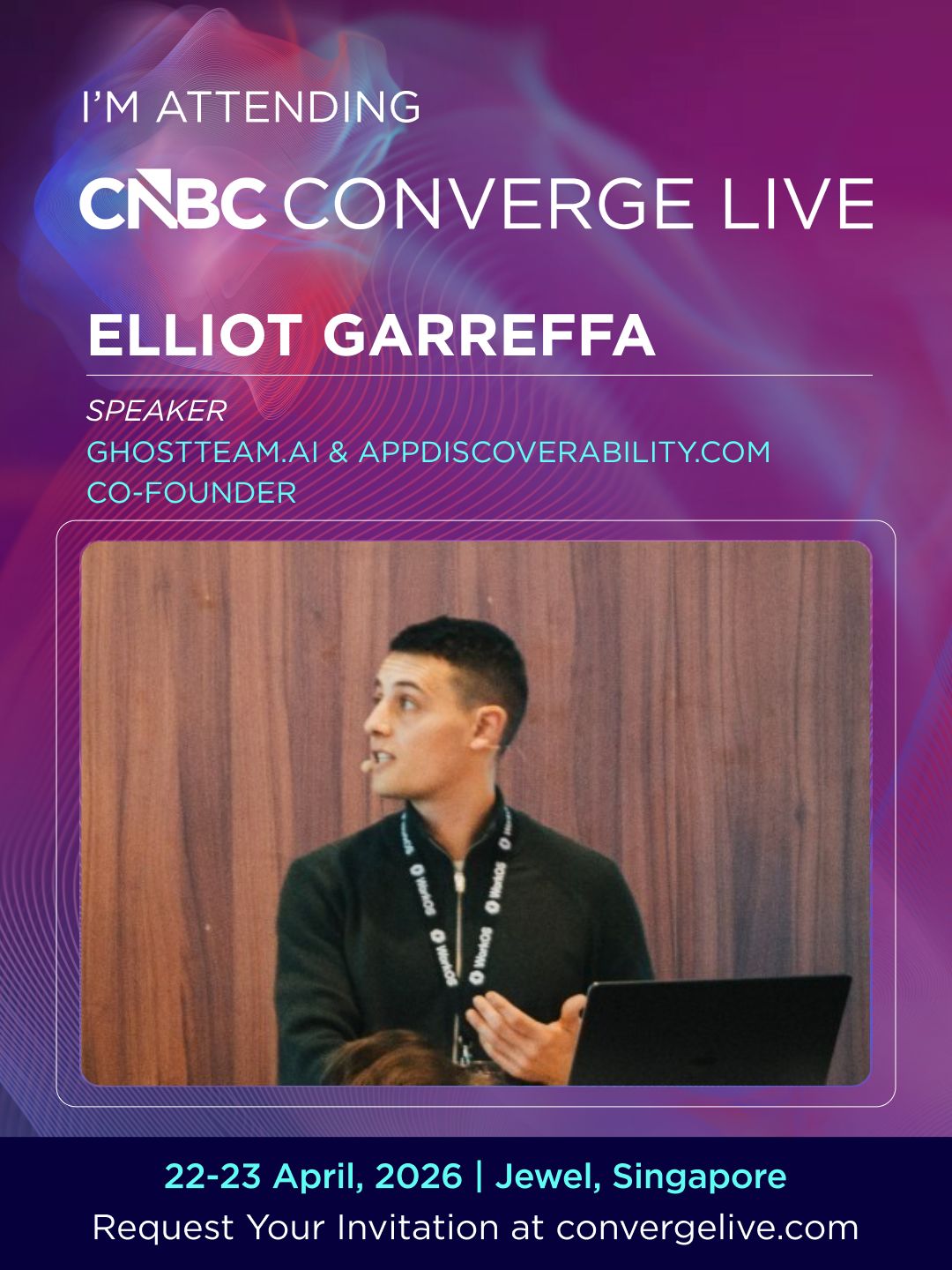
CNBC invited me to speak at a roundtable on 'Beyond Buzzwords: AI for Real Business Value.'
Excited to share what we're seeing at Ghost Team AI working with some of the world's leading enterprises to move past the hype and actually ship AI that delivers.
The 23rd Prime Minister of Canada Justin Trudeau and Singapore's Deputy Prime Minister Gan Kim Yong will also be giving talks which is cool.
It's my first time speaking in Singapore. Can't wait - more on this soon.

If you’re thinking of building or building an ChatGPT App or MCP App, I’d love to hear from you! What are you excited about? What are you finding difficult?
Feel free to drop a reply to this email.
Happy building,
Elliot
If you want help building your MCP app or figuring out your cross-platform distribution strategy, book a strategy call with our team at Ghost Team.
We've been in this space since day one.